Selected chapters · By Aestra

Aestra’s Dragon Shelf

How to Please a Very Large Dragon

By Aestra · 4 selected chapters

Chapter 2

A Second Helping, If You Please

The housekeeper had laid supper for two and removed the chair on Merelle’s side. “His lordship thought you might sit nearer.” Merelle looked at the enormous dragon, then at the cushion beside his foreleg. “His lordship has hired a herbalist.” Veyr pushed a covered dish toward her. She lifted the lid and recognized the very mushroom that had once emptied her stomach into a magistrate’s hat. Refusing a dragon’s food was an insult; accepting it would be a medical demonstration neither of them wanted. “Your table honors me,” she said. “That particular ingredient does not agree with my continued dignity.”

He listened, called for another dish, and made the housekeeper fetch an actual chair. Merelle began to relax until she saw her name engraved on the silver cup. “This is a twelve-day appointment.” “I thought you might stay.” “You have not yet heard the diagnosis.” “I was thinking beyond the diagnosis.” She turned the cup so the housekeeper could not read it. The woman had already read it, understood it incorrectly, and gone to tell the kitchen. Merelle took a second helping. It was going to be difficult enough to conduct this examination without being hungry. The housekeeper reappeared with a cushion. “For the examination.” Merelle asked why it was heart-shaped. “We have had time to prepare.” Veyr looked delighted. Merelle began adding a surcharge for witnesses.

Chapter 6

An Appetite for Something Harder

Merelle found the missing piece of the garden wall beneath Veyr’s tongue. He refused to meet her eyes. “Your physicians told me you had lost your appetite.” “Not for everything.” The gardener had blamed invading soldiers; the housekeeper had blamed Merelle. Neither theory explained the powdered white stone in the dragon’s water basin. She compared it with a fragment from the ridge he had been forbidden to visit. The vein carried the salts his scales and breath required. Three deer and an expensive tonic were not substitutes for a mineral the tonic’s inventor had never bothered to identify.

“You are not becoming naturally unbearable,” she said. “Someone has prescribed an incomplete diet.” Veyr looked relieved, then offended on behalf of all the years he had been unbearable without assistance. Merelle took the physician’s list of forbidden foods and wrote the location of the ridge across it. “Tomorrow we begin here.” “Together?” “Unless you prefer someone who charges by the syllable.” He placed the largest of the stolen stones beside her chair. “A gift.” She regarded the brick dust on her appointment book. It was the least romantic offering she had ever received, and the first that made her genuinely hopeful. “You have finally found something hard enough to satisfy me,” Veyr said. Merelle held up the rock before the housekeeper could enter. “Minerals.” “Of course, madam.” The woman took the door handle with both hands to keep it from rattling.

Chapter 8

A Delicate Matter of Horns

“Higher,” said Veyr. Merelle climbed another rung and discovered why the other attendants had preferred to admire him from below. Beneath the branching horn, a loose scale had caught against tender new growth. He could break a gate with that horn but could not reach its base with his claws. “May I work the loose edge free?” she asked. At his agreement, she used a soft brush rather than the silver instrument the physician had recommended. Veyr’s shoulders dropped. From the doorway, the housekeeper made a small sound of professional vindication.

Merelle was too occupied to correct her. Beneath the scale lay a chalky paste, packed into the fold until every movement rubbed it against the new skin. She scraped a sample into a jar. The physician’s signature scent rose from it. “There,” she said, releasing the scale. Veyr lowered his head until her ladder was almost unnecessary. “You might stay up there a little longer.” “I have what I came for.” She held up the sample. He regarded the tiny jar with unmistakable disappointment. Merelle smiled despite herself, then descended to ask who had approved the announced ceremonial application of exactly the same paste. The housekeeper met her at the bottom. “Was his horn to your satisfaction?” Merelle presented the jar. “The problem was a thick application in a difficult fold.” They stood together in the awful silence of an entirely correct sentence.

Chapter 13

The Night the Bed Began to Tremble

The innkeeper knocked for the third time while Merelle searched for the pen she had dropped beneath the bed. “If the gentleman continues, madam, I shall have to charge for the plaster.” On the adjoining terrace, Veyr lay with his wings loose and his breathing regular. The sustained vibration in his chest traveled through the beams and made the washbasin shiver. It was a contented purr, quite unlike the short, braced warning she had heard at his gate. “He is comfortable,” Merelle called. “Yes,” said the innkeeper. “The whole establishment has noticed.”

Veyr had brought an offer to purchase her practice and reserve her services. He watched her reading it with the hopeful certainty of someone presenting a solution. Merelle laid the document beside her widow’s ring. Her late husband had also called it kindness when he arranged a life in which she could never be absent. “This says I would belong to your household.” The purr faltered. “You would never have to worry about money.” “That is not the worry I am asking you to understand.” Downstairs, the furniture finally stopped trembling. For the first time that evening, the innkeeper had reason to fear the silence. Then the innkeeper slid a bill under the door: One room. One terrace. Structural enthusiasm. Merelle disputed the last item. “Madam,” he called, “the people in room six have asked what you charge.”

Swampy Ties

By Aestra · 3 selected chapters

Chapter 2

Something More Personal

Orlana had brought two sheep, a silver bowl, and a speech about mutually advantageous access. Avar ate a sheep while she was still delivering the second sentence. The bowl earned a glance. The battered little bell tied to her survey bag stopped him entirely. “Where did you find that?” It had come from a drowned stone doorway her employer described as an old cattle shelter. Orlana untied it. “You may have the silver as well.” “I have silver.” His attention remained on the bell, though it was worth less than the ribbon she had dressed for him in.

He asked whether the doorway faced the rising sun. She said it did. He asked whether there were three niches above it. Her employer’s drawing showed none, but Orlana remembered placing her fingers inside them to pull herself ashore. “It was a shrine,” Avar said. Suddenly the visit was no longer about purchasing a dragon’s patience. He had identified something that would invalidate the easiest survey of her career. Orlana took out her notebook. “You might invite me to sit before ruining my prospects.” He moved aside. The place he offered was dry, warm, and inconveniently close to the evidence. Under Tribute, she wrote, “Livestock inadequate; he preferred something I had personally pulled from the mud.” She read it back, shut the notebook, and decided she could explain the shrine in person.

Chapter 8

Meet Me Where Nothing Stirs

“After moonrise, where the water is still.” Orlana had taken considerable trouble over an invitation that supplied so little advice about footwear. She reached the lake with mud on her hem and found Avar studying its surface. Between the reflected stars ran pale branching threads she could not see in the sky. Avar caught her hand before she could throw a pebble at his reflection to obtain his attention. “The ripples would erase the high currents.” His wingtip followed one luminous thread northward. He had not come to drink. He had come to find a passage.

“Is that where you go when you disappear?” she asked. He showed her where the reflected lines broke around the mountains. On a clear, quiet night they gave him information the open sky withheld. Orlana marked the bearing beside the drowned shrine on her map; other dragons using the same crossing might have seen what happened there. She had arrived prepared to accuse him of keeping secrets and was leaving with a better question. “You could have written ‘bring a notebook,’” she said. Avar looked at her carefully chosen ribbon. “Would you have worn that?” She did not answer quickly enough to preserve the dignity of the survey. Her final note was, “For best results, remain still beneath him until the stars become visible.” It described her position beside his reflection exactly. It would nevertheless require a diagram.

Chapter 15

Evidence on His Pillow

Orlana found silver-winged moths among Avar’s cushions and an empty space where the rain-bell’s companion tablets had stood. She had already imagined another visitor when one of the insects settled on a freshly shed scale. Through her lens, she saw its tiny larvae feeding on the fragment’s fading enchantment. Molt-moths: the creatures she had dismissed as a decorative nuisance in his old resting chamber. That chamber had contained only dry husks. Here the colony was feeding. He had rested in this gallery recently, after moving the tablets, not abandoned it years before as her employer’s agent claimed.

Fresh wing dust led to the upper ledge, where the tablets lay wrapped against the coming reclamation work. Avar landed as she lifted the first. “I thought you had gone back to submit your report.” “I was about to.” She read the names cut into the stone and recognized a surviving family her employer had paid to ignore. “That would have been an expensive mistake.” “For whom?” Orlana folded her blank certification and put it beneath the specimen jar. It made an excellent surface on which to count moths. The report that would cost her the commission required a clean sheet. “I found something fluttering where you sleep,” she said. Avar looked at the jar. “Moths.” “I am aware.” It was a relief to have a witness who could identify the evidence without first asking whether she was jealous.

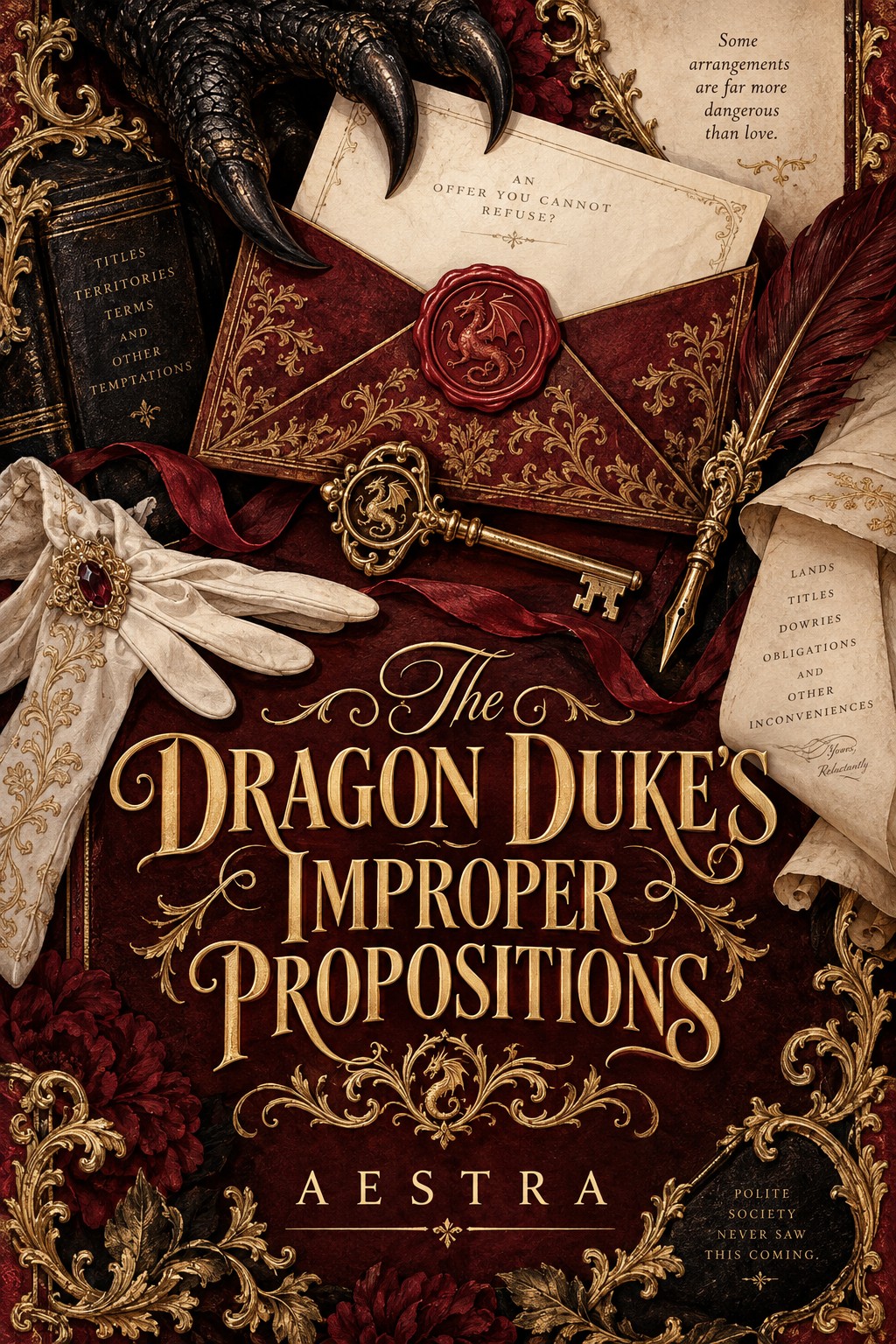
The Dragon Duke’s Improper Propositions

By Aestra · 5 selected chapters

Chapter 2

An Invitation to Come Inside

Isolde reached the duke’s private entrance carrying a treaty, a midnight appointment, and a dispatch addressed in a hand far more familiar than diplomatic protocol required. The door stood open. With the outer servants absent, she could have inspected the first archive cabinet before anyone announced her. Stone murmured under her slipper. She stopped outside the threshold. “Lady Isolde, requesting admission.” An immense eye opened beyond the lamplight. “Requesting is an improvement.” Behind her, the groom who had sworn he saw nothing found a buckle requiring his full attention.

“Your letter said the entrance would be unattended.” “It did not say it would be unobserved.” Isolde waited until he actually invited her across, then set the treaty on the table with the private dispatch carefully beneath it. A dragon might expect a visitor and still object to being surprised by one. She would put that in her report, provided she could find a version that did not explain the hour. The duke moved the chair beside his own. “Which business first?” From the courtyard came the sound of the groom retreating at speed. By breakfast, Isolde suspected, there would be only one answer anyone believed. The groom’s report would begin, “Her ladyship announced her intention to enter him.” He had meant his residence. He would remember to add that eventually.

Chapter 6

Nothing to Hide, Several Things to Discuss

“Were you sent only to discuss the winter road?” The duke asked while Isolde was retrieving her glove from beneath his map. She could say that the road was the reason she had come tonight. Every word would be true; the belief she intended him to take from it would not. His stillness discouraged the experiment. “I will not answer that question,” she said. He did not bare his teeth or proclaim that he knew the hidden instruction. He simply drew the archive key back toward himself.

“Then that cabinet remains private.” It was a consequence she could accept and a boundary she could no longer pretend was unclear. Isolde put her hand flat on the map instead of following the key. “Can we continue with the road?” He nodded. They worked until the lamp failed and she began reading distances from memory. At the door, he returned the glove himself. “You could have made tonight easier.” “For whom?” His answer took long enough that she looked back. He was still holding the key, as though it had become considerably heavier than it had been before supper. Her official account read, “His Grace withheld his key after I declined to disclose my other business.” The embassy returned it with three question marks and a request that future negotiations occur before supper.

Chapter 9

Say It in That Voice Again

“Stay,” said the duke. Isolde had her cloak in one hand and the archive key’s reflection in the window. Her tutor had taught her flawless Draconic, and the word alone could have been an order. Beneath it, a low answering note moved through the duke’s chest: the same tentative harmony she had heard when he asked whether the villages still sang the old winter song. Not command. Hope. She put the cloak down. “Until the treaty is finished?” “That is one possible interpretation.”

She asked him to repeat it, then tried the word herself. Her throat produced a sound that would have embarrassed a defective bassoon. The duke’s answering laughter nearly put out the fire. “Your vocabulary is excellent,” he said. “Your accompaniment needs work.” For once she let him see her laughing too. Later, when he left to fetch an older map, the key remained beside the lamp. Isolde had understood the undertone correctly; he was beginning to trust her. It made reaching for the key much harder, and did not, to her lasting shame, stop her hand. Her practice note said, “I can manage the words, but he produces the vibration.” The embassy’s language tutor underlined vibration twice and requested a demonstration. Isolde applied for a different tutor.

Chapter 12

You May Stay Until I Ask You to Leave

The copied agreement lay beneath Isolde’s shawl. She knew it was visible because the duke had stopped looking at her face. “I offered you shelter,” he said. “I did not offer you that.” She reached for the language of hospitality, the protection he had explicitly granted when she accepted his table. “You said I was your guest.” “You were. Return the copy and leave.” The words were quiet and complete. Whatever restraint guest-right had placed on him did not survive a clear dismissal.

There were arguments she could make: the hungry settlements, her instructions, the narrow legal meaning of theft. Each would keep her inside after she had been told to go. Isolde laid the copy down and crossed the threshold before speaking again. “May I send a new proposal?” “From outside my boundary.” She nodded. The groom returned her horse without a joke; the silence was worse than his earlier curiosity. On the ride back, she drafted an agreement that would save the winter road without the stolen authority. For the first time, it would have to contain the truth about what she had done. She struck out “His hospitality was withdrawn while I was still inside” and began again. The road treaty now seemed the easier document.

Chapter 20

Do Try to Restrain Yourself

The first line of Isolde’s confession vanished beneath frost. The duke had listened without interruption while the room grew steadily colder. Her fingers would not hold the pen. “Your Grace, restraint,” she said. Once, that phrase would have earned a smile. Now he looked at the white lace advancing across the treaty and closed his eyes. The frost withdrew from the paper and gathered against his scales. It was a deliberate effort, and she waited until the ink moved freely before continuing.

He could quiet what his presence did to the room; he could not make the words she had written hurt less. Isolde signed the clause surrendering her diplomatic protection. He signed the passage agreement without using her exposed position to demand anything more. Only after the copies were sealed did he return her abandoned shawl. “You left this.” “I left rather quickly.” The pause contained several invitations they had become too honest to confuse with treaty terms. “Supper?” he asked. She accepted, then checked the chair before sitting. The duke watched her do it and, at last, laughed. “You have restrained yourself admirably,” she said. He glanced at the treaty. “Shall that go in the minutes?” “It shall not.” The secretary, halfway through writing admirable restraint, made the error of asking why.

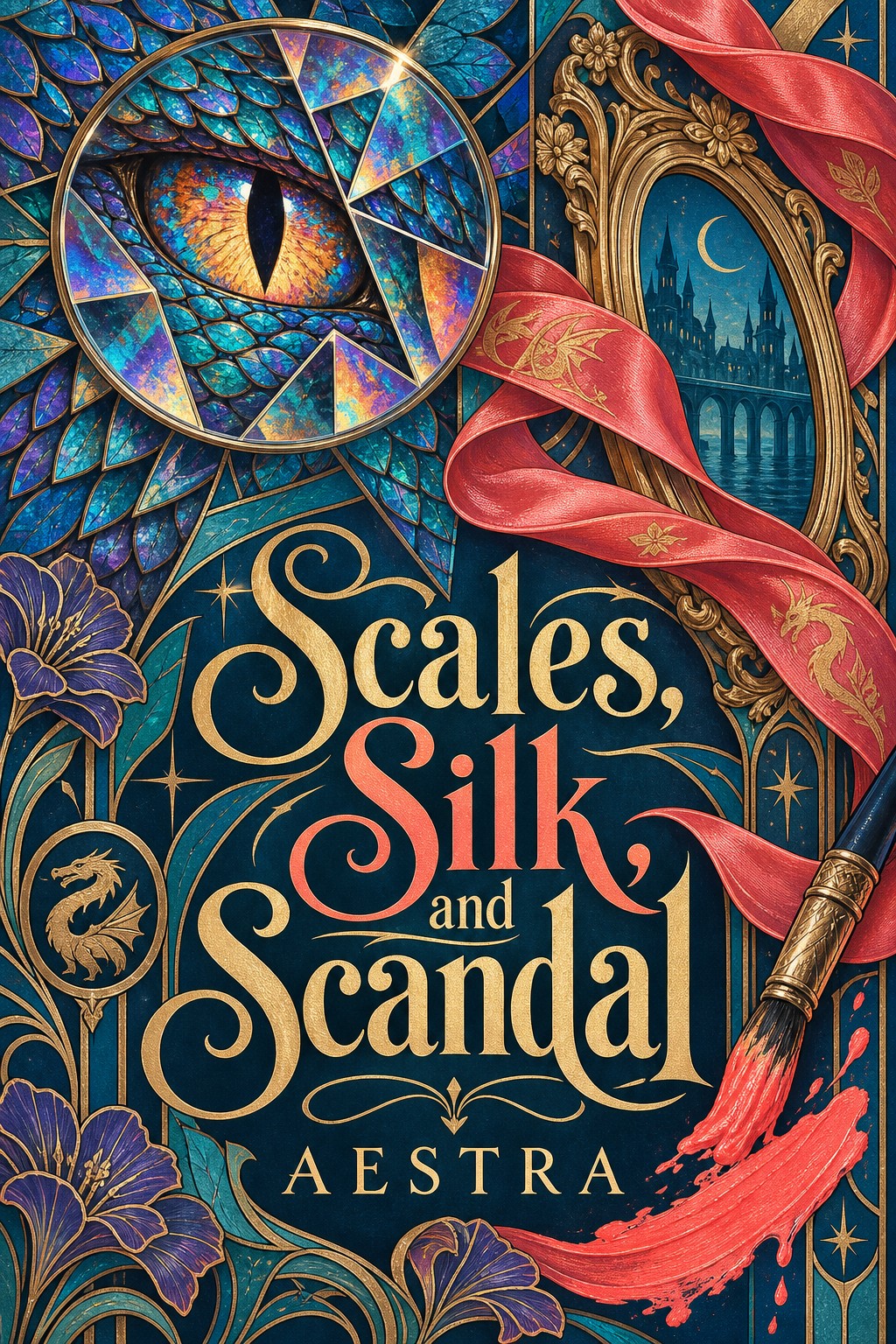
Scales, Silk, and Scandal

By Aestra · 5 selected chapters

Chapter 3

A Gentleman in Nothing but His Colors

“You have painted me brown.” Celise set down the most expensive black pigment she owned. “I have painted you in natural light.” Theryn regarded the canvas as though it had repeated a private insult. He slid a treated lens across the table. Through it, the apparently dark wing displayed fine violet bands and a spray of green markings that ended beneath his shoulder. Celise forgot the speech about artistic judgment. “Hold that position.” “You have been asking me to move for an hour.” “I have spent an hour working with inadequate information.”

She fetched fresh paper and made two studies: what ordinary eyes perceived, and the pattern the lens revealed. Neither resembled the approved likenesses hanging behind him. Theryn watched her compare them. “The others were content with my instructions.” “The others did not have this view.” It came out considerably warmer than professional criticism required. He moved the lens closer to her chair. She moved it back to the worktable. Whatever the household might conclude about the prolonged sitting, Celise now had a defensible reason to ask him to spread the wing again—and a growing suspicion about every painter who had not. The clerk recorded, “Subject spread himself repeatedly at the artist’s request.” Celise added “one wing.” The clerk obligingly squeezed it between the lines, where it looked like an excuse.

Chapter 7

Something New Beneath the Old

Celise placed three portraits against the studio wall and asked Theryn which relative he had been impersonating. He looked from one heroic likeness to the next with the expression of a patron reconsidering his advance. “All me.” “Then somebody has misplaced an entire branch of your left horn.” He opened a cedar chest. Inside lay a cast taken before his last great molt. The old proportions matched the earliest painting; the later ones should have changed. Horns, wing structure, even the distribution of his power had developed. The official artists had simply copied what was already approved.

She traced the edge of the cast without touching him. It explained the new horn, not the scar missing from every subsequent portrait. “How much was I expected to copy?” Theryn’s gaze moved toward the exhibition contract. Celise followed it and understood why the sitting had been so comfortable while she was flattering him. She turned the newest official likeness to face the wall. “I charge for a portrait, not a more recent date beneath an old one.” He said nothing. For the first time since arriving, she wondered whether she would be invited back into the studio tomorrow. The studio clerk chose that moment to ask whether she required more time with the gentleman’s previous skin. Celise said yes. He wrote it down, slowly, on a form whose heading was Personal Preferences.

Chapter 10

An Intimate Arrangement

Theryn offered Celise a flawless shed scale and suggested she use it as a reference for the damaged shoulder. She put it beside her drawing. Fine lines within the loose fragment ended at its edges; on his living body they continued across neighboring scales, joining into a changing pattern that carried light around the scar. Repeating the perfect fragment would not reproduce that arrangement. It would paint a dragon that could not work as he did. Celise drew the joining lines while Theryn watched her pencil approach the place he preferred not to discuss.

“You could make it less noticeable,” he said. “I could also give you three matching wings. Both would be inventions.” He withdrew the offered scale. She did not reach to stop him. The portrait had ceased to be a pleasant reason to spend afternoons together, and she missed those afternoons badly enough to resent the truth. Then he set the scale down again, imperfect side upward. “Show me what connects there.” Celise turned the drawing toward him. She could not promise that he would like it. This time, he asked to see it anyway. She labeled the study His Pattern, Laid Bare. “A little intimate,” Theryn observed. “It is a diagram.” “So is your other drawing. You locked that one in a cupboard.” She turned the paper over.

Chapter 16

A Very Small Demonstration

Celise rejected the fourth proposed pose: mountain beneath the claws, defeated army conveniently out of frame. “I know you can destroy something large.” Theryn stared at the thumbnail sketch as though the little soldiers had betrayed him. Then he picked up a pearl from the sitter’s table. With the tip of one massive claw he cut a groove finer than her pen could manage, turned it, and lifted a petal from the curved surface. No great flare of magic. No collapsing masonry. He worked until a rose stood intact upon its tiny stem.

Celise leaned forward so quickly that her brush rolled into the washwater. “Do that again.” His expression became intolerably pleased. “For the portrait?” “Eventually.” She placed the pearl near the scarred shoulder in her composition. Neither feature concealed the other: the wound showed what he had survived, the rose what he could control. For once, he studied her drawing without requesting an alteration. Celise retrieved her brush. It was the first time he had offered her something she could admire without making herself less truthful to accept it. The exhibition label would say An Impressive Performance on a Very Small Surface. “Shall we mention the pearl?” Theryn asked. “We shall put the pearl first.” He looked disappointed by her sudden commitment to clarity.

Chapter 22

Time Has Not Finished With Me

“Why the scar?” asked the patron, just before the cloth came off. “Surely a creature of his age ought to look beyond such things.” Celise kept her hand on the cord and waited for Theryn. He had survived centuries; he had not passed beyond learning, injury, or the possibility of death. The old portraits had made age look like a shield. Hers showed a living dragon whose body had changed and whose abilities were still changing. It was exactly the image he had paid her not to make.

He could stop the unveiling with a word. Instead he lowered his head until he could see the pearl rose in the painted foreground. “Take it off,” he said. The room went silent for the wrong reason, and Celise discovered that she could still blush in front of an entire exhibition. She pulled the cloth. Someone objected to the wound; someone else moved closer to examine the extraordinary little carving. Theryn listened to both without demanding a correction. Afterward, he asked whether she would paint him again. “When you have changed,” she said. He looked almost young with anticipation. The society correspondent’s next column began, “At her subject’s urging, the artist removed the last concealing cloth.” Celise sent a correction. The following edition printed it under Further Revelations.

A Lady’s Guide to Riding Dragons

By Aestra · 4 selected chapters

Chapter 3

Not That Entrance

Bellane pointed to the gap between the ridges and reminded Rhask that she was paying by the journey, not by the view. He landed short of it. Along the approach, arranged bones gave way to deep paired claw marks; beyond them, stone had been scored in a different repeated pattern. “Hunting ground,” he said, indicating the first. “Private approach. Nursery.” She consulted her map. Its author had drawn a cheerful little arrow through all three. “There is no warning on the survey.” “There is a warning on the mountain.”

The marks were not a language every dragon wrote alike; Rhask recognized this particular neighbor’s distinctions. Bellane crossed out the arrow while something enormous shifted behind the ridge. She had been moments from announcing a rescue mission by trespassing into a defended nest. “The longer way, then.” Rhask lowered the riding harness without a word. She fastened it herself. Under the guidebook heading How to Secure Prompt Service, she added a line about asking why a competent guide had stopped. It was the first useful sentence in the chapter and, so far, the least flattering to its author. Her next heading was Never Assume He Wants You to Use the Rear Entrance. Rhask read over her shoulder. “Accurate.” “I shall find another way to phrase it.” “Why? Will your readers not need directions?”

Chapter 8

A Firm Grip and an Open Mind

Rhask turned north against a wind that had been pushing them east. Bellane tightened the harness and prepared the sentence beginning For the fee I am paying. His wing membranes trembled before the turn, feeling something her face could not. They climbed through apparently still air along an invisible bend. Far below, another dragon took the same curve. “Not all the currents are wind,” Rhask said. “My wings can feel the others.” Bellane swallowed her complaint and took out the map she had promised not to wave near his eyes.

At the next ledge she marked the curve against three visible peaks. Rhask had never needed to explain it to someone following on foot; she had to know where a supply team could reach his landing points. They argued over distances until her hands stopped shaking. “You might have warned me before changing direction.” “You might have asked why.” Bellane drew a small star beside the safe ledge. What had looked like an extravagant detour could take food above the blocked pass. She would still dispute the bill. First, she needed him to show her the route again. She titled the revised instruction Grip Firmly: He Can Feel Things You Cannot. Rhask approved it without hesitation. Bellane began to suspect she was writing a book she would never be able to recommend to her mother.

Chapter 17

An Indecent Descent

The bronze dragon climbed, vanished behind the eastern spur, and returned beneath his companion in a long, elaborate descent. Bellane reached for the distress flag. Rhask stopped her. “He is telling her how he reached this valley.” The next sequence included a separation, a return, and a maneuver at which Rhask became conspicuously interested in the weather. “What was that part?” “Personal.” Bellane lowered the flag. She had nearly interrupted a love story by declaring an aerial emergency, which would have done very little for relations on the ridge.

The opening climb had followed the gap above the travelers’ last known camp. When the performance ended, Rhask called across to ask whether its narrator had seen the blocked stream below. He had. He also knew a ledge the rescuers could use. Bellane added it to the plan, resisting the temptation to record the rest of the performance as a universal flight dictionary; Rhask had recognized a tradition, not translated every turn in the sky. “We owe him thanks,” she said. “For the ledge?” Rhask asked. “And for answering questions in a less elaborate form.” Bellane had titled the sketch He Went Down Magnificently. “It was a descent,” she told Rhask. “A very good one.” “Then I do not understand why you are crossing it out.” Neither did she have an explanation she intended to give him.

Chapter 24

Separate Rooms, Considerable Distance

Bellane’s patron offered Rhask accommodation in the capital, three attendants, and an annual salary. He declined before the third attendant was mentioned. On the journey he had recognized rival markings, exchanged news across valleys, and called on a former acquaintance for help. None of those dragons lived together. Their shared customs survived through encounters and the raising of young, not streets or councils. Bellane folded the proposed appointment. Her revised guide now contained rather fewer references to civilizing one’s traveling companion.

“There is a ridge above the western lake,” she said. “The landing is adequate, and the inn serves something you did not complain about.” Rhask considered her. “When?” “After the spring roads open. I shall announce myself.” It was not a claim upon his territory or the purchase of another rescue. He gave her a date. Back in the capital, Bellane’s secretary asked whether the dragon had accepted a position. “No.” “Then what have we secured?” She opened a fresh page. For once, she did not dictate the answer. The secretary waited, pen raised. “A private engagement,” Bellane finally said. “At what distance?” “Several mountain ranges.” He began a new form. Her most intimate arrangements were developing an alarming transport budget.

Hot Breath, Hard Promises

By Aestra · 4 selected chapters

Chapter 5

Terms Before the Fire

Drazhul read the lighthouse commission and placed a claw on the word supply. “You have hired a cart?” Ilyne had spent three days obtaining his interest and very nearly wasted them by saying that the cart would have been cheaper. He regarded what his breath transformed as his workmanship, not an anonymous service. Without clear terms, they were preparing two different objects: hers to deliver, his to retain. She drew a clean line through supply and wrote collaborate. “Then we agree what belongs to whom before you touch it.”

They settled the stone, the completed prism, the fee, the attribution, and the declaration that no further debt remained. Drazhul objected to the small lettering of his name. Ilyne enlarged both signatures equally. It was the first concession either had made without regretting it. Only then did she notice that they had worked through supper. “Your contract is remarkably thorough,” he said. “My last partner preferred promises.” “Did they satisfy you?” She capped the ink. “The workshop still owes money.” He did not ask the next question, which improved her opinion of him considerably. The invoice required a description of services. Ilyne wrote, “One sustained application; all materials supplied by the client.” Drazhul asked whether she would be satisfied with one. She broke the nib.

Chapter 11

Less Force, More Finesse

The first sample broke with a sound like a struck wineglass. Ilyne wrote too much, too quickly beneath the trial number. Drazhul read it over her shoulder and looked offended. “You asked for a powerful result.” “I asked for a light sailors can depend on. They will not thank us for an impressive explosion.” She altered the support so the next sample could expand evenly. He changed the breath from a combat discharge to a narrow, sustained working exhalation. The cloudy interior cleared slowly without the surface splitting.

Ilyne watched through the shield until the light reached the edge, then signaled for him to stop. He stopped. That small cooperation pleased her more than the brilliance on the table. His control would have failed in her earlier mounting; her improved mounting could not have survived his earlier force. “Again?” he asked. She numbered the next sample and moved her stool beside his working position. The patron’s letter promised a generous reward to whichever of them deserved the credit. Ilyne used its blank reverse to record what both of them had just done. For the minutes, she dictated, “My mounting was inadequate for his initial enthusiasm.” The workshop clerk put down his pen. Ilyne pointed at the brass jig. “Draw it. Please draw it before you show anyone that sentence.”

Chapter 17

It Isn’t Finished Just Because It’s Hard

The patron’s men arrived with velvet padding, an armed escort, and instructions not to keep the unveiling waiting. Ilyne put the small testing light to the prism. Green, then amber, then a flickering white. Its surface was hard; the magical structure inside it was still settling. “It cannot travel.” The patron’s steward tapped the delivery clause. Drazhul quietly offered enough gold to purchase her share of the contract and end her difficulty. It was a generous solution to every problem except the one she was trying to become strong enough to face herself.

She repeated the same small test before the witnesses. The responses differed again. “Moving or enchanting it now may spoil the work. I will sign a delay, not a false result.” The steward threatened to publish the refusal. Ilyne gave him paper. Drazhul moved the empty transport cradle out of reach and sat beside the workbench, waiting for the next test rather than buying her decision away. Outside, the herald began the ceremony without its centerpiece. Inside, they waited for the same question to produce the same answer. The steward tried the title of her report aloud: “It Isn’t Finished Just Because It’s Hard.” “Correct.” “Must I read that to the patrons?” Ilyne checked the next measurement. “Until they understand it.”

Chapter 21

Something of You in It

Ilyne knew the unveiled prism was not theirs before the crowd finished applauding. Its setting used her drawings; its light did not match any of their trials. She placed one of the retained samples under the same test. A faint amber branching appeared, the individual affinity Drazhul’s working breath had left in their material. The substitute answered differently. That alone did not name its maker, but it gave her a comparison the steward could not dismiss as wounded pride. She asked him to produce the delivery seal he had accused her of withholding.

He could not. Drazhul remained still while Ilyne laid out the records, the sample, and the unsigned receipt. The signature in the crystal did not make it his property by magic; their contract settled that. It did make replacing their work harder than copying her measurements. Afterward, he inspected her notes. “You recognized something of me.” “I recognized a repeated test result.” “You keep rather many.” Ilyne put the smallest stable sample in her personal case instead of the archive. This time, she did not bother improving the explanation. In her private inventory she wrote, “A small, hard reminder of his finest work.” She stared at the sentence, added “prism fragment,” and then underlined it with sufficient force to leave an impression on the next three pages.

The Dragon’s Large Lusty Load

By Aestra · 5 selected chapters

Chapter 4

More Than Meets the Eye

By dawn, Miren had crossed out council, invasion, and several less defensible descriptions of the gathering beyond the cedar screen. An orgy was not a useful word to write in an expense report. Safely away from it, she asked Vardas about a female dragon whose wing markings matched a male she had sketched years earlier. “The same individual,” he said. Her notebook had assigned two names. Dragons possessed both reproductive systems; the female structures were normally concealed behind the external male anatomy. What she had treated as two kinds of dragon was a change of phase.

Miren joined the records with a firm pencil line. It solved the identification and doubled the embarrassment: she now knew exactly whose private evening she had interrupted. “You might have corrected the old drawing sooner.” “You did not ask me to identify myself sooner.” He indicated the safe path again without asking her to remain. At the inn, the clerk saw the crossed-out names and asked whether she had met a council. Miren considered how much easier her life had been while that explanation still seemed possible. “No,” she said. “A rather different arrangement.” “One dragon, two records,” she added. The clerk reached for the guest register. “Will they require one room or two?” Miren covered her face. She had discovered a new question to which a correct answer would not help.

Chapter 10

The Terms of the Contest

The constable laid Miren’s lost notebook on the tavern table. He had found a sketch of an injured dragon beside the words private gathering and assembled a theory with admirable speed. “We believe you have witnessed a crime.” “You have witnessed my filing system.” She separated the pages. One recorded an earlier reproductive duel. Loss of the defeated dragon’s external male organ determined the female role for that cycle; the victor remained the potential sire. Whether a pairing followed was a separate judgment of worthiness. The drawing did not record what had happened behind the cedars.

The constable reread his warrant. “Then where is the prisoner?” “There is no prisoner in either of these accounts.” Miren wanted to discuss the subjects without an audience, a rescue party, or her aunt standing behind the beer barrels. She had acquired all three. She dated each page and placed the descriptions in order. Clinical distinctions would not restore her reputation, but they might stop twelve armed volunteers from making themselves unwelcome to dragons who had already let her leave. The constable finally lowered his sword. Her aunt asked about the cedars. “For the record,” the constable said, “please repeat the explanation.” Miren looked at his entirely blank page. “You wrote none of it down?” “I was hoping it would become a different explanation.”

Chapter 15

Call Again in Ten Years

The searchers returned with news of a female dragon asleep beneath the northern escarpment. Their captain described this as further evidence. Miren described it as a location she had already marked nine years earlier. “She laid an egg,” she said, turning the old page over to show the date. The reproductive cycle involved roughly a decade of regrowth and renewed capacity; an egg-bearing dragon often slept through much of that recovery. An absence from recent sightings was not proof that somebody at the cedar gathering had hidden an injured captive.

“So she will wake tomorrow?” the captain asked. Miren put down her pencil. “Approximately a decade is not an appointment.” Nor could she decide from a distant glimpse why every sleeping dragon slept. This account mattered because she had its history. He reluctantly erased a second arrow from the rescue map. Her aunt, who had been counting the years aloud, asked when Miren first became interested in the dragon’s private life. “Before it became a public emergency,” Miren said. It was accurate, unhelpful, and the only answer she could currently defend. The captain had written “Call again in ten years” beneath her name instead of the dragon’s. “That is not my availability,” Miren said. Her aunt asked why she had needed to clarify.

Chapter 20

A Different Proposition

Miren caught the captain’s arm before he could sound the horn. On the far side of the clearing, the female dragon had announced a challenge; the volunteers assumed Vardas was about to attack someone unable to take part. “Listen to what she is asking,” Miren whispered. A female-configured adult could contest its worth as an egg-bearing partner without competing to become the sire. This dragon was not asking to be rescued. She was asking whether Vardas would meet an opponent who believed herself considerably stronger than he remembered.

“And you learned this while you were missing?” the captain demanded. Behind him, every volunteer leaned closer. Miren had reached the end of explanations involving surveys and unusual weather. “I accidentally witnessed a private adult gathering. I left it. Nobody abducted me. Put the horn down.” Her voice carried farther than she intended. Both dragons turned. For one remarkable moment she had the complete attention of two species and no wish to possess either. Then Vardas pointed toward the road she had already been shown, and the volunteers finally took the hint. The captain attempted one final whisper. “What sort of gathering?” Unfortunately, the whisper was addressed to the speaking end of his horn. Miren closed her eyes. The forest had excellent acoustics.

Chapter 25

Relative Strength — Naturalist’s Afterword

The editor had drawn one branching tree where Miren supplied three tables. It was elegant and wrong. Among dragons, close biological relatedness did not itself impose a reproductive viability penalty, nor exclude fully mature, independent adults from eligibility. That was an observation to record, not a mechanism she could explain merely by calling dragons ageless. She restored the first table as a record of biological descent and the second as a record of adult pairings. Neither table described the private gathering that had made her travel report notorious.

The third recorded who had actually guarded and taught each brood. Several names appeared there without appearing in the corresponding ancestry. Rearing, not a genealogical line, established the work of parenthood. “Readers will prefer one tree,” the editor said. “Then label it incomplete,” Miren replied. She retained the separate tables, the uncertainty about inheritance mechanisms, and the distinction between independent adults and dependent young. The editor complained that this was an unusually demanding conclusion to a comic novel. Miren finally understood how the dragons must have felt when the rescue party arrived. “Could we at least call it a family tree?” he pleaded. Miren spread the three tables across his desk. “Which family?” The editor stared at his coffee. It had gone cold during a discussion he had expected to be about adjectives.

Hard-Won Affections

By Aestra · 8 selected chapters

Chapter 1

There Is More Than One Way Back

Ilara found the white dragon above the tarn, striking the same narrow ledge until the rock gave way. The encounter that had placed her in the female phase had ended without an accepted pairing. She could have withdrawn to hibernate, sought a less formidable willing partner, or remained awake to develop enough strength for another attempt. “You chose the ledge,” Ilara said. The white dragon struck again. This time the fracture ran cleanly to the edge. “The ledge,” she answered, “does not congratulate me for almost succeeding.”

Ilara had come for directions, not a possible future. She watched until she could distinguish frustration from practice. The white dragon was changing the angle of each attempt, learning rather than merely repeating the defeat. Before Ilara left, she indicated the pass toward Sarveth’s territory. “Take something there he has not already beaten.” Ilara looked back at the broken stone. The advice made the distant dragon less inviting and considerably more interesting. She changed her route to the steeper climb, where the wind would require an answer her wings had not yet learned. At the pass she rehearsed, “I have come because you look difficult.” Then she tried, “I believe I can manage you.” By sunset she had abandoned both introductions and decided that announcing her name would cause the least trouble.

Chapter 3

Do Not Go Easy on Me

Sarveth named the place where their contest would begin, then suggested avoiding the crosswind at the western edge. Ilara stared at him. She had spent the journey learning to use difficult air. His considerate alteration would remove exactly what she meant to test. “Do not improve my chances for me,” she said. He could admire her and still underestimate her; she had no intention of letting him disguise that mistake as kindness. The point of the pairing duel was their full effort, not the result either wished to give the other.

He studied the western edge again. “Then you will not thank me for holding anything back.” “I will know you have.” The answer made him smile in a way she had not seen during the careful introductions. He returned the crosswind to their agreed ground. Ilara felt the temptation to be pleased with his approval and put it aside. Tomorrow she would need an opponent she could trust to try to defeat her. Affection that asked less of either of them would have made the entire journey unnecessary. “I want your best,” she said, “and I intend to make you regret giving it.” Sarveth began a reply. She lifted one claw. “That was a challenge. If you make it a compliment, we shall be here all night.”

Chapter 4

Make Me Work for It

Ilara heard the stone stop falling before she trusted her own breathing. Sarveth stood above the shattered ledge, one wing held carefully clear of the rock. She had lost. That did not answer the second question. An opponent could be defeated and dismissed as inadequate, leaving the reproductive challenge without a pairing. She waited for his judgment with none of the clever remarks she had rehearsed on the journey. He looked toward the crosswind she had twice turned against him. “I had to change my answer,” he said.

He accepted her. Relief arrived beside anger, pride beside the sharp knowledge of what had beaten her. Sarveth seemed to think the contest had settled the important matter between them. Ilara looked at the damaged ledge and began remembering exactly how he had recovered his balance. “You are studying it already,” he observed. “Would you prefer I had learned nothing?” His expression changed. Perhaps he understood, then, that accepting the result was not the same as agreeing to remain the person it described. Their next conversation began with what each intended to do differently. “So I was adequate.” “Formidable.” “You hesitated.” “I was choosing the word.” “Choose it sooner next time.” There were advantages to admiring someone with teeth. One remembered to be precise.

Chapter 6

Keep Watch Until I Return

Ilara watched Sarveth rearrange the nursery stones for the third time. The single egg lay where the sheltering wall met the warm floor. She had expended what producing it required; he had won the responsibility of guarding it and raising what would emerge. Many bearers hibernated through much of recovery, while the sire remained active with the young. Their duties did not require one residence. Her chosen refuge was beyond the ridge, far from the exposed approach he needed to keep under observation.

“You moved it again,” she said. “The morning wind reaches farther than you thought.” She checked, found that he was right, and disliked how pleased he looked. He expected her to comment on the arrangement. Instead she asked what he would teach the hatchling when it first misjudged a landing. They argued until the light changed. It was a useful argument: by the time she left, he had stopped treating the nursery as a victory and begun considering the individual he would have to prepare for life beyond it. “You may have won,” Ilara said, “but you are still putting the windward support on the wrong side.” Sarveth checked. She was right about the support. He made the adjustment with the air of someone conceding a separate, smaller battle.

Chapter 8

Not Sleeping Through This Part

The sheltered cavern remained empty while Ilara watched dawn move across the lake. Everyone who had seen her prepare it assumed she would sleep there through recovery. Instead she practiced the slow turn Sarveth had used to escape her crosswind. Some dragons remained female; some stayed awake between reproductive opportunities. Neither choice made the intervening years cease to be part of a life. She rested when she needed to and made no claim that determination could shorten the work her body still had to do.

When Sarveth next saw her, he asked whether she had recovered early. “I have awakened each morning,” she said. “Those are different things.” He looked from her to the pattern of disturbed water beneath her practice route. She had expected him to be impressed by the improvement. Instead he identified the predictable point where she lost speed. Ilara nearly told him she had not requested instruction. Then she tried his observation and found the turn smoother. It was infuriating to miss someone and wish he would leave in the same moment. “I did not invite you here to improve my technique.” He watched her repeat the corrected turn. “Shall I forget what I saw?” “You might begin by forgetting how pleased you look.” He made a visibly inadequate effort.

Chapter 11

The Morning After Independence

Sarveth watched the last of the brood’s supplies disappear into the distance with the now-independent dragon that no longer needed him to choose a route. The nursery was quiet. He had expected relief and found restlessness instead. Beyond the northern heights lived an opponent whose recent flights suggested new power; elsewhere, Ilara had been developing answers to their old contest. Guardians could face challenges while rearing, but the end of that work released his attention for a deliberate search. He wanted the strongest worthwhile rival he could actually find, not the most convenient familiar name.

He cleared the last practice stones from the approach and left before the light had reached the rear wall. Ilara found the empty ledge later and understood from its orderly condition that he had not fled a disaster. He had finished something. A mark on the northern overlook indicated his departure, not a request that she follow. She resented the difference long enough to notice it. Then she turned toward her own training grounds. Meeting him again would mean more if she brought a life he had not spent the intervening years supervising. On her way out she noticed his practice marker: Try Again. Apparently it applied to both of them. She turned it to face the northern route, which accomplished nothing except making her feel briefly better.

Chapter 14

Come Back When You Mean It

Ilara recognized the opening movement and prepared the answer she had spent years perfecting. Sarveth completed the demonstration above the lake without using the escape she expected. He had found a better one. Her hard-won counter belonged to a version of him that no longer existed. A rematch normally meant something had changed; she had imagined that change almost entirely on her own side. “You were going to ask,” he said as he landed. She could have issued the challenge out of pride. Instead she asked to see the movement again.

He showed her, giving her no comforting mistake to exploit. Ilara watched until she understood why copying his strengths would always leave her measuring the distance behind him. “Not today,” she said. Sarveth did not hide his disappointment. It pleased her, and she refused to let that become the reason she stayed. The next time she came, she would not bring an improved response to his old question. She would bring something he had not taught her to ask. She departed west, toward the weather he preferred to avoid. “When shall I expect you?” he called. “When your confidence has become expensive.” He considered that invitation long after she vanished. It was the most promising threat he had received in years.

Chapter 23

Earn the Next Chapter

The young dragon failed Ilara’s favorite turn three times and succeeded at a movement she had not intended to teach at all. It could hold almost still against the crosswind, making tiny adjustments she found maddeningly difficult to describe. Its inheritance offered extraordinary possibilities. It did not promise that every strength would be hers, or that every offspring would simply exceed the adults that produced it. She moved the practice marker. “Again,” she said, this time asking for the movement the young dragon had actually discovered.

At dusk, she looked across the old contest ground and understood something about Sarveth she had resented learning from him. Raising a powerful dragon demanded more than admiring the advantages with which it began. Someone had to watch, correct, and recognize when the lesson should change. She removed the marker that would have forced the young one into her own preferred route. In its place she set a harder problem suited to its unusual balance. It solved that problem badly, then better. Ilara found herself more pleased by the second attempt than by any resemblance to her own wings. The young dragon asked whether Ilara had done it correctly on her first attempt. “Eventually.” “That is not what I asked.” She recognized her own insistence on precision and regretted that particular inherited advantage.

Yours Until the Next Challenger

By Aestra · 10 selected chapters

Chapter 2

A Considerable Collection

Voskar counted three eggs through the gap in the nursery wall. Kaerun saw him counting and did not bother concealing his pride. A large nest could embody victories over dragons whose own victories had already gathered a brood. The eggs did not grant the courtesy normally extended to a guardian teaching hatchlings. They made the adult guarding them worth considering. “You have collected a considerable responsibility,” Voskar said. Kaerun stepped clear of the entrance. He knew an inquiry about the nursery when he heard one, and this was not it.

Rhyssa watched from the opposite ridge while the two chose ground well away from the eggs. She had expected Voskar to wait for a less encumbered opponent. He had come precisely because the responsibility was substantial. Kaerun would not be leaving it untended without arrangements, nor would Voskar be allowed to treat it as incidental afterward. Rhyssa looked back at the three different shells. The approaching contest would produce one clear result between the adults. What that result meant for the eggs would take much longer to discover. Voskar practiced the expression he would wear after winning. Rhyssa watched Kaerun check the nursery supports one more time. She suspected the expression would not survive an introduction to the repairs.

Chapter 4

All of It, Not Just the Pretty One

Voskar paused over the bright-veined egg nearest the entrance. Its shell caught the light beautifully; the dull one behind it barely seemed warm. Kaerun followed his gaze. “All three.” An accepted victory over their guardian transferred the dependent brood in full, including offspring with no biological relationship to the victor. Voskar could not take the striking egg and leave the uncertain one as somebody else’s problem. He moved his body between the entrance and the entire nest, discovering that protecting all of it required a rather less comfortable position than displaying himself beside the best shell.

Rhyssa waited until Kaerun had finished describing the nursery before speaking. “A large collection,” she said. Voskar heard admiration and nearly answered accordingly. Then she asked which egg lost heat fastest after sunset. He did not know. Kaerun did. Voskar looked back at the defeated dragon and asked him to continue. It was his first useful act as guardian: admitting that victory had transferred an obligation faster than it had supplied the knowledge needed to fulfill it. “Should I record the victory?” Rhyssa asked. “In a moment.” He was listening to an explanation of drainage. She allowed him the dignity of finishing it before observing that the moment appeared to be getting longer.

Chapter 5

None of Them Look Like You

The oldest two eggs belonged biologically to neither Voskar nor Kaerun. The record stones named earlier adults and earlier transfers; their different shells told a less complete story. Rhyssa found Voskar comparing those shells to Kaerun’s scales and asked what he expected to learn. “Where they came from.” “Then read the stones.” Color alone could not reconstruct ancestry, and successive guardianship changes had already separated ancestry from the adult standing at the entrance. One egg had crossed two such changes before Voskar arrived.

He moved the record stones where he could study them without leaving the nest exposed. For a moment he resented the complication: he had defeated one dragon and inherited the unfinished histories of several. Then the smallest egg shifted against its support, and he forgot which history belonged to it while preventing the fall. Rhyssa watched him settle it beside the others. “Does that one resemble you?” she asked. Voskar adjusted the support again. “It resembles something that needed a better place to rest.” It was the first answer she did not challenge. Rhyssa glanced at the ancestry stones. “Shall I read the next account?” “Does it explain this loose support?” “No.” “Then this one has priority.” He had inherited a genealogy and discovered a maintenance schedule.

Chapter 6

An Expanding Arrangement

Voskar arranged the three record stones by date and concluded that Kaerun had produced eggs with remarkable speed. Rhyssa turned the oldest stone over. Its last date recorded a transfer, not its laying. One egg had passed to a new guardian, a later reproductive event added another, and a subsequent accepted challenge brought the growing responsibility to Kaerun. The third egg belonged to another event. A nest could expand because existing eggs moved through guardianship, not because one dragon suddenly began laying them in batches.

He rebuilt the order with three lines instead of one. The accounts contained long gaps he could not fill and short intervals he could not interpret without knowing more about each egg. At least the impossible clutch disappeared. Rhyssa looked over the corrected arrangement and asked where he would put the egg expected after his own accepted pairing with Kaerun. Voskar examined the nursery’s sheltered space. Until that moment, four had been a pleasingly impressive number. Now it was a practical question with no spare warm corner. “I had expected a celebration,” Voskar said. Rhyssa considered the crowded floor. “Celebrate by moving that support.” It was becoming clear that the prize included a great many sentences beginning with move.

Chapter 7

One at a Time, All at Once

Kaerun brought one egg. Voskar had cleared room for it and, on advice he now suspected was useless, left another space beside that. “There is no second,” Kaerun said. A dragon laid one egg from a successful reproductive event. The three already sheltered behind Voskar came from other events, accumulated through the history he had only just learned to read. The new arrival made four dependents, not a sudden four-egg clutch. Voskar moved the unnecessary support before Rhyssa could see what he had expected.

She saw it anyway. “You have given the empty place better shelter than the old egg.” He checked the draft, found she was right, and rearranged the whole nest rather than protecting only the new arrival. Kaerun waited until the supports held steady before withdrawing toward recovery. Voskar had imagined that adding one egg would complete something. Instead it changed where he could rest, how he watched the entrance, and which repairs mattered before dark. Four remained a number worth pride. It simply refused to remain only a number. On the nursery plan he changed Victorious Acquisitions to Things That Must Not Roll Downhill. Rhyssa read it. “Your scholarship improves.” He put a stone on the corner of the plan. That must not roll away either.

Chapter 9

Still Waiting for the Right Conditions

Voskar warmed the quiet egg again and watched nothing happen. The others had changed since entering his care; this shell remained as it had been when Kaerun left. He began preparing to move it away from the active nest. Rhyssa stopped beside the old record stone. It described a previous resting chamber with a different magical environment. Some eggs suspended development when the conditions they needed disappeared. A cold, unresponsive shell could be waiting rather than dead, and increasing the temperature did not supply everything a nursery might lack.

They moved the heat source back before it damaged what it was meant to help. Voskar compared the surviving notes, separating observations from guesses and admitting how little the transfer had told him. Restoring suitable conditions might resume development; deciding what those conditions were required work. He returned the egg to a secure place where it could be watched rather than forgotten. Rhyssa stayed long enough to help examine the chamber. For once, neither spoke of how the other would have performed in a contest. The shell gave them a question strength alone had not answered. “I defeated the previous guardian,” he said at last. Rhyssa studied the unanswered temperature notes. “Did you remember to defeat the draft?” He went to fetch another stone.

Chapter 11

Someone Is Listening

Three taps answered the phrase Voskar had been repeating while checking the supports. He stopped. The egg stopped. When he tried again in the same tone, a faint pulse passed beneath its shell. Late in development, an unhatched dragon could distinguish recurring voices and sounds. Kaerun’s old nursery account had mentioned this, but Voskar had expected something more impressive than an answer to “not that way, the stone will roll.” He repeated the phrase carefully. The shell tapped once, which was either recognition or an opinion.

He brought the older voice records near enough for comparison and discovered that one egg answered a familiar cadence more readily than his own. That did not make it somebody else’s property or guarantee it would obey either speaker. It meant it had been listening longer than he had been talking to it. Voskar began narrating the evening’s small repairs. From the ridge, Rhyssa heard a guardian explaining a wall to an egg with complete seriousness. She did not interrupt. He had finally found an audience for whom his voice needed to become more than a warning. He tried a heroic account of his last victory. Nothing. He returned to the wall repair. Tap. Rhyssa looked away with tremendous courtesy. His first unfavorable review had arrived before its reviewer had hatched.

Chapter 15

Who Stayed

The quickest hatchling reached the marker first and waited for praise. The smallest had not left the sheltered ledge. Voskar could identify which young were biologically connected to him, but that distinction settled none of the morning’s work. All depended on his protection and instruction. He shortened one route, made another harder, and spent the longest part of the lesson beside the hesitant one. A common destination did not require identical practice. The ancestry stones remained in the rear chamber, useful records and useless answers to the question before him.

Later, a visitor asked which were truly his. Voskar indicated the whole brood, then returned to the young dragon struggling with balance. Earlier guardians had left recognizable lessons and remembered voices; his present work did not erase them. Nor did those memories diminish the responsibility he had accepted. By sunset the smallest had reached a lower marker without help. Voskar waited for it to come back before moving the marker again. That evening he remembered the successful return more clearly than any name carved into the stones. The visitor began again: “But which ones are yours?” Voskar gave him the patient look ordinarily reserved for a pupil failing a very simple lesson. “Would you like me to move the marker closer?”

Chapter 19

Do Not Interrupt the Lesson

Rhyssa arrived while Voskar was teaching the brood to judge an unfamiliar descent. Most dragons would have waited until the young became independent. A guardian with hatchlings was not invulnerable to challenge, but interrupting that instruction made a claim sharper than ordinary rivalry. Rhyssa believed her advantage substantial enough that waiting would cost the young better training. Voskar heard the claim in full. He had once been pleased simply to hold more eggs than another dragon. He was considerably less willing to have the work since then dismissed as an interval between contests.

He finished the lesson before answering. They made arrangements for the brood’s protection and chose ground beyond the nursery, where the contest would test the adults rather than frighten their dependents. “You could have waited,” he said. “I believe I should not.” There was no easy insult to return; she was either arrogant or right, and the difference mattered to individuals he now knew. Voskar looked once toward the practice ledge, then followed her away. He would bring more to this fight than the strength with which he had first entered the nest. “And if I win?” Voskar asked. “Then you keep teaching.” He considered the glorious possibilities of dragon rivalry. Even its finest outcome involved going back to work.

Chapter 24

Not What Anyone Expected

The young dragon that loved the rain left a lace of frost on the departure ledge. Nobody had confidently predicted it from the ancestry stones. Inherited traits opened a range of possibilities; surroundings and formative experiences helped determine which affinity became dominant. Another broodmate had developed along a very different path despite sharing the nursery. Voskar examined the frost without announcing that rain lessons had caused it. The history offered an observation, not a dependable method for producing the same result in another egg.

Rhyssa came to watch the departures and found the once-crowded chamber almost empty. The independent dragons carried habits Voskar recognized and powers he could not claim to have designed. “Not what you expected,” she said. He watched one of them make a turn better suited to its own balance than the maneuver he had originally taught. “No.” It was not disappointment. Once the last had left, he moved the practice stones clear of the entrance. The nursery no longer needed his constant attention. Somewhere beyond it were rivals who had continued becoming stronger while he learned how to teach. The notes labeled Guaranteed Results had become a tray for loose stones. Rhyssa noticed. “A useful theory, then.” Voskar put one more stone on it and declined to defend the title.

The Heart Wants What It Hoards

By Aestra · 2 selected chapters

Chapter 3

You Brought Someone Else

Corin had arranged the flowers so Tavia would have to move them to make room for an argument. The jewel case waited beneath his folded napkin. Their dragon host glanced toward it before either lover mentioned a gift. “Who came with you?” Tavia looked at the empty place settings. “We came alone.” The host did not touch the case. “Not everyone here arrived that way willingly.” Corin’s hand stopped over the clasp. Velvet, a silver lid, and a coat pocket had concealed the jewel from eyes, not whatever the dragon perceived within it.

Tavia moved the flowers after all. “Where did you buy it?” Corin started with the name of the respectable auctioneer, then stopped himself and gave her the broker’s real name. It was the name he had promised never to use again. That admitted one wrong; it did not prove he had known about the occupants. Tavia opened her appraisal book on the clean tablecloth. “We are going to separate those questions.” The supper remained untouched while she wrote. For the first time that evening, Corin told her something difficult before she had to discover it for herself. “I had hoped tonight would be intimate,” Corin said quietly. Tavia looked at the jeweler’s receipt. “Then you might have started with a gift that did not require an investigation.” He removed the romantic place cards. They needed space for questions.

Chapter 17

Not an Empty Vessel

The claimant’s jeweler transformed an empty stone without damaging its setting. “There,” he said. “Perfectly safe.” Tavia placed four names beside his demonstration. The chain of sale recorded them against the same jewel Corin had brought to supper. “You tested the container.” “There is only one object.” “There may be four people.” Dragonfire could act upon the souls separately from the vessel that held them; making the outside look intact answered none of her questions about what would happen within.

Corin stood between the claimant and the closed case. He had once tried to repair their relationship by making a beautiful purchase and explaining it afterward. This time he waited for Tavia’s answer before moving anything. She refused the procedure and asked that the records and jewel be secured together while they sought qualified help. They had not freed the occupants by saying the correct words. They had prevented an attractive demonstration from becoming an irreversible experiment. Outside, Corin offered to carry her coat. Tavia handed him the evidence ledger instead. It was considerably more trust. “Was that a good first step?” he asked. Tavia considered the ledger in his hands. “Yes.” He smiled. “Do not make me issue a certificate.” He managed to put the smile away before she had to produce a form.

Ashes, Appetites, and Other Unfinished Business

By Aestra · 1 selected chapter

Chapter 3

Hard Evidence

Rowan opened the parcel expecting the compass Tessa had borrowed before their last quarrel. A crystalline curve lay in the wrapping instead. “This is a remarkable way to return an instrument.” “It is modern dragon bone.” He turned it beneath the lamp. Modern remains crystallized after death; what looked ready for a jeweler’s window had once belonged to a living skeleton. It was not a shed scale, nor proof that the entire creature had been mineral while alive. Tessa watched him make those distinctions and remembered exactly why she had wanted him beside her in the first place.

“You have brought a comparison,” he said. “What am I meant to compare it with?” She took the second parcel from her bag but did not immediately open it. On their previous journey she had announced the conclusion before showing him the evidence. He had asked her to reverse that order; she had called it a lack of faith. Now she placed the wrapped object beside the first. Rowan cleared space on his desk. He had not agreed to travel. He had, at least, made room for the question. Her accompanying note read, “I thought of you when I found something unusually hard.” Rowan placed it face down. “You could have written dragon bone.” “You would not have opened the letter.” He could not entirely dispute that.